Research, step by step
Tirzepatide injections: reading symptoms after a shared treatment history
A guide to defining the comparison, separating observation from treatment receipt, and judging which evidence could support a change in product or delivery.
Published · 11 minute read
An injection can be described by its ingredient, its delivery system or the experience reported after using it. Those descriptions answer different questions. A symptom percentage belongs to a particular measurement; it does not automatically evaluate every feature of the process that preceded the report. Reading the evidence carefully begins by deciding which question matters, then identifying the observations that could answer it.
This analysis uses a study figure as a starting point for original methodological interpretation. The central problem is how to reason about continuing an intervention when the comparison begins after an earlier treatment history. We examine the definition of the intervention, the boundaries of the observations and the evidence needed before transferring a conclusion to another product. The goal is a precise scientific question, rather than a broad reassurance assembled from an isolated bar.
Wide tables can scroll horizontally. Keyboard users can focus a table region and use the arrow keys to move across it.
Reading the evidence
- Define the target
- Specify the decision and the people whose experience the proposed conclusion would describe.
Sources: [2]
- Describe the intervention
- A product name alone is an incomplete specification for a reproducible comparison.
Sources: [2]
- Keep the measurement intact
- Presence, recurrence, duration and intensity require different summaries.
Sources: [2]
- Read the observation rules
- Study contact and treatment receipt belong on separate timelines.
Sources: [2]
- Test the proposed transfer
- A new delivery claim needs evidence addressing the feature that changed.
Sources: [2]
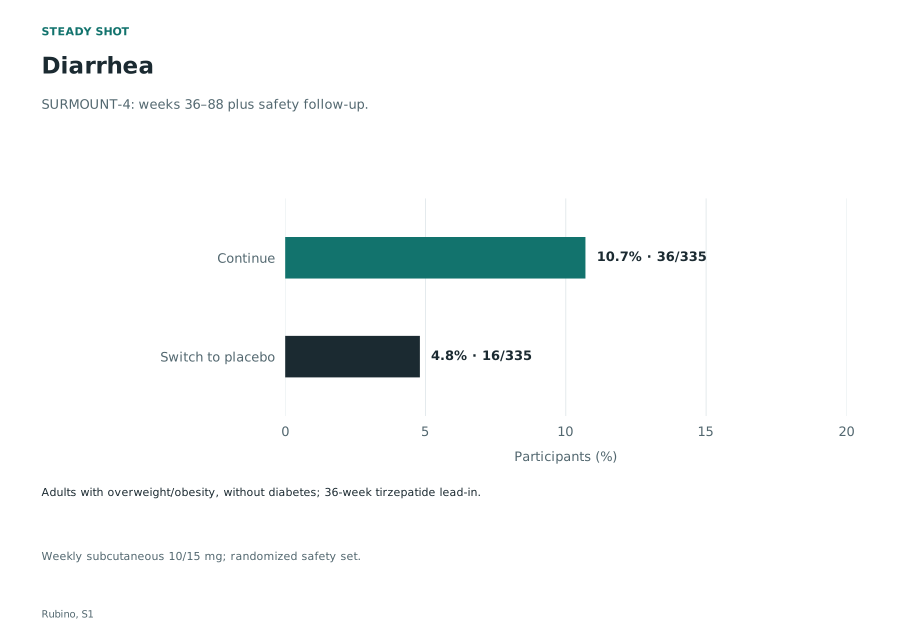
Diarrhea
SURMOUNT-4: weeks 36–88 plus safety follow-up.
Adults with overweight/obesity, without diabetes; 36-week tirzepatide lead-in.
Weekly subcutaneous 10/15 mg; randomized safety set.
Sources: [2]
| Assignment | n/N | Percent |
|---|---|---|
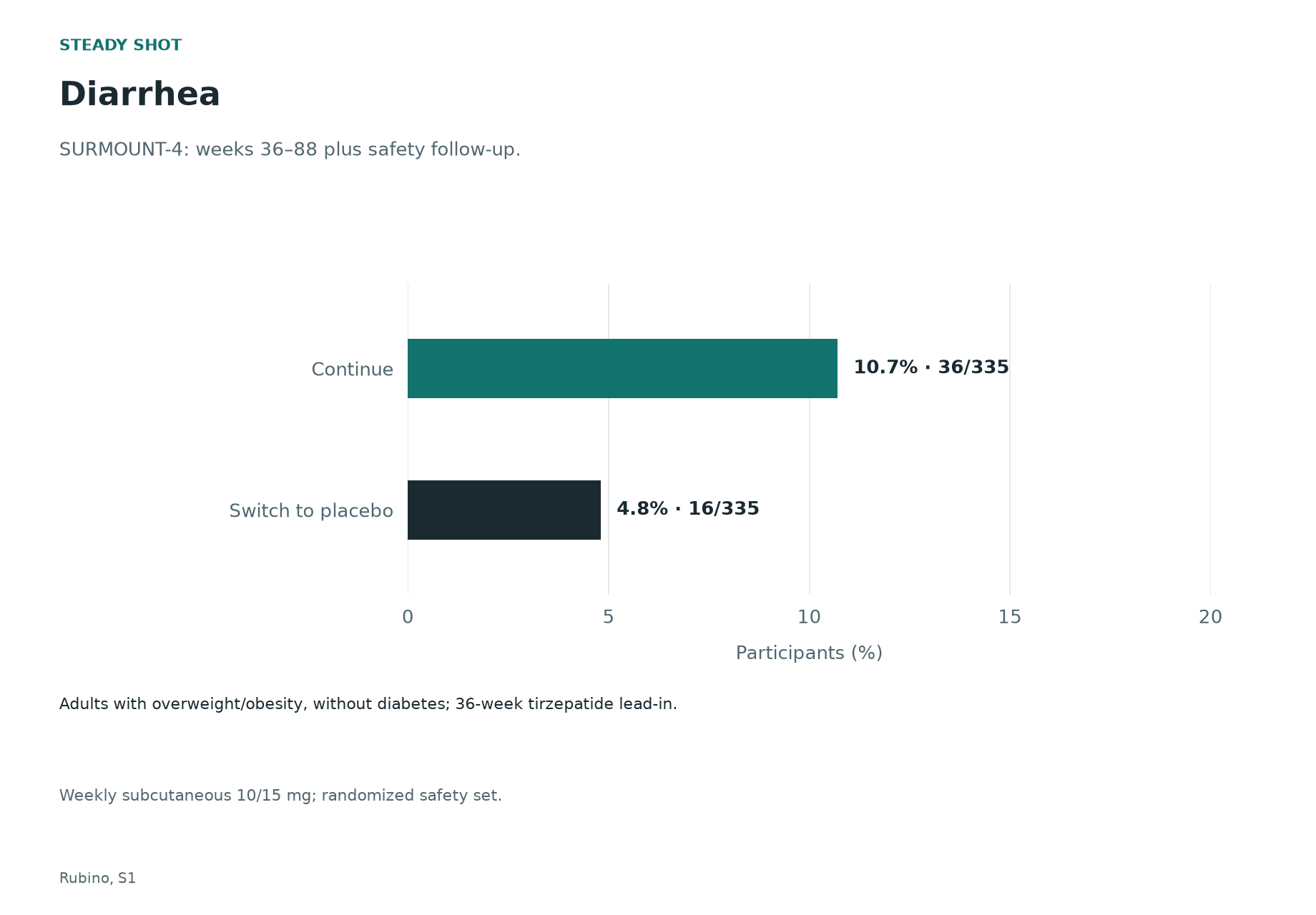
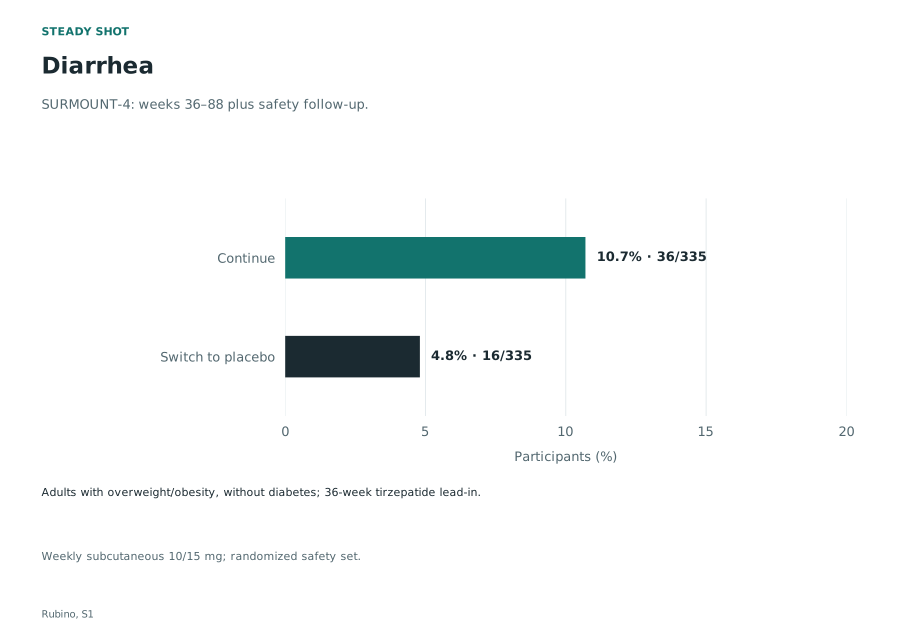
| Continue | 36/335 | 10.7% |
| Switch to placebo | 16/335 | 4.8% |
Begin with the question behind the measurement
Rubino’s post hoc analysis included a withdrawal design; Lilly funded the study, with six employee-shareholder authors.
Consider the difference between asking whether a symptom was reported and asking whether an injection was delivered as intended. The first question requires a symptom definition and a rule for recording its presence. The second requires a specification for intended delivery and a measurement of what occurred. Neither measurement can substitute for the other merely because both concern an injection. A research conclusion should retain the vocabulary of the outcome actually measured.
This distinction also separates describing an outcome from explaining its cause. An observed experience might motivate several hypotheses, but a proposed mechanism requires evidence capable of distinguishing those hypotheses. The scientific response is to name a discriminating observation: what would look different if the explanation were correct? Without that step, a causal story can sound persuasive while remaining compatible with several conflicting explanations.
Our interpretation therefore treats the figure as a bounded observation. Questions about effectiveness, delivery performance and continued use should be developed as separate research questions. This is a way to preserve useful evidence while making the next investigative step explicit.
Sources: [2]
Specify what would count as the same intervention
To reproduce a comparison, another investigator needs more than an ingredient name. A useful intervention description identifies the material being administered, its presentation, the intended route and the process used to deliver it. These features can be described separately even when a particular study evaluates them together. Separating the descriptors helps reveal exactly which part of an intervention a proposed generalization assumes will remain unchanged.
The reverse mistake is to assume that any visible difference proves a different clinical result. A different container or delivery arrangement raises a question; it does not supply the answer. The appropriate comparison depends on the proposed claim. A claim about accurate delivery requires evidence about delivery. A claim about clinical outcomes requires an outcome assessment capable of detecting a meaningful difference. Agreement on one measurement need not settle every other measurement.
The prescription-reading guide provides a separate reading destination for examining product descriptions. In scientific terms, the task is to turn each description into an operational definition: a rule another investigator could apply consistently. That makes an assertion testable without assuming that a product difference is either harmless or harmful.
| Proposed change | Comparison to establish | Unresolved assumption |
|---|---|---|
| Different delivery device | Assess intended delivery under relevant conditions | Similar appearance establishes similar performance |
| Different product presentation | Specify the material and relevant measurable properties | A shared ingredient name settles every product question |
| Different administration process | Define and compare the steps that affect the outcome of interest | Instructions alone demonstrate actual performance |
| Different support arrangement | Measure the particular process or outcome claimed | An outcome from another setting transfers automatically |
Sources: [2]
Give the comparator a history
A comparison becomes clearer when each strategy is written as a sequence rather than a label. Keeping an established intervention and changing it after an earlier period are different sequences. A comparator introduced at the beginning of treatment would represent a different sequence again. The histories matter to the definition of the question even before any claim is made about their biological consequences.
This reasoning does not establish a carryover effect, its direction or its duration. It identifies information that a causal question must specify. If a reader wants to know about starting treatment, evidence focused on a later decision point requires an additional argument about applicability. That argument would have to explain why the earlier history and the conditions for reaching the later decision do not alter the comparison of interest.
The companion semaglutide analysis develops the problem of identifying who reaches a comparison. Here, the useful exercise is to write the desired question in complete form: among which people, after which history, compare which next actions, for which outcome? A familiar comparator name should never replace those specifications. They determine what a result would mean if the comparison were repeated.
Treat the footnote as part of the result
A table cell is inseparable from its definitions. The row identifies what was measured, the column identifies the group, and the accompanying notes identify the rules under which observations were counted. Reading only the cell removes part of the measurement. It is similar to copying a distance without preserving the unit: the number remains visible while its interpretation becomes unstable.
A practical hierarchy starts with the definition attached to the particular result. Broader methods descriptions provide context, but they should not silently overwrite a more specific rule. If two passages appear to describe different populations or periods, the reader should first ask whether they concern different analyses. Combining them into a single imagined method can create a claim that neither passage supports.
The same discipline applies when studying a symptom timeline. Before comparing dates or percentages, identify the event that starts the clock and the rule that ends observation. A discrepancy in wording is a reason to inspect scope, not a reason to invent missing procedures. Where the accessible record cannot resolve an ambiguity, retain the uncertainty and state which interpretation depends on it.
Sources: [2]
Draw separate timelines for receipt and observation
Treatment receipt and observation are separate processes. A person could remain available for study contact while their treatment history changes; conversely, a record of intended treatment does not by itself establish complete observation. A rigorous question therefore needs a definition of exposure and a definition of surveillance. Treating these as separate variables makes it possible to ask where information is present and where it would need confirmation.
For an investigation of temporal relationships, the relevant records would include administration dates, symptom onset, subsequent reports and the end of contact. The analyst would also need rules for uncertain dates and overlapping periods. These are requirements for answering a proposed question, not assertions that any particular event occurred or that investigators failed to collect it. A summary figure cannot reconstruct an individual sequence simply because its axes are precisely labeled.
The missed-dose and storage guide is a separate practical reading destination. The methodological issue here is narrower: changing a timeline changes the question being estimated. An analysis based on assignment, an analysis based on documented receipt and an analysis based on continued observation need explicit definitions before their results can be compared.
Sources: [2]
Choose the endpoint before choosing the summary
A binary indicator asks whether a defined event occurred. A count asks how often it occurred. A duration measure asks how long the experience lasted. These summaries are related, but converting one into another requires information that the first summary may discard. A person-level indicator intentionally compresses a history into a simpler record; the lost detail cannot be restored by more confident language.
The choice of endpoint should follow the question. If the question concerns interruption of ordinary activity, merely recording symptom presence would leave the central feature unmeasured. If the question concerns recurrence, a separate episode rule would be needed. Such rules must explain when one episode ends and another begins. Otherwise, different observers could produce different counts from the same underlying history.
Our first-injection guide addresses another reading context; this table instead maps scientific questions to measurements. It is an original framework, not an additional set of trial findings. The aim is to show why a reassuring answer to one narrow question may still leave a different, reasonable question open.
| Outcome sought | Data required | Conclusion unavailable from a symptom proportion |
|---|---|---|
| Recurrence | Episode definitions and repeated event records | How often an experience returned |
| Duration | Onset and resolution dates with missing-date rules | How much time the experience occupied |
| Functional impact | A defined assessment of disrupted activities | How much the experience affected daily life |
| Delivery performance | Direct measurements against an intended-delivery specification | Whether administration met its specification |
| Continued treatment | Receipt and interruption records with explicit definitions | Whether treatment continued without change |
Sources: [2]
Distinguish changing treatment from losing information
An investigation of continued use needs to decide what continuation means. Does the question concern remaining assigned to a strategy, receiving it without interruption or returning after a change? Those definitions describe different outcomes. A study should choose the definition before examining results so that the rule does not shift to favor the most appealing interpretation of what happened.
Loss of information introduces another issue. Ending treatment and ending contact are conceptually distinct events, even when they occur together. To evaluate missing follow-up, an analyst would need to know what became unavailable, when it became unavailable and which assumptions permit a conclusion despite that gap. The direction of possible bias cannot be inferred merely from the fact that information is missing.
The guide to stopping a GLP-1 is a separate educational destination. For evidence assessment, the important next step would be a planned analysis of treatment changes and observation patterns, with sensitivity analyses that vary uncertain assumptions. A sensitivity analysis asks whether a conclusion survives plausible alternative explanations for missing information; it does not manufacture the observations that were never available.
Sources: [2]
Ask what would establish equivalence
Even if two groups produced matching percentages on a selected outcome, that observation alone would not establish that their products were equivalent. Equality of displayed values could conceal uncertainty, differences on other outcomes or limitations in the comparison. An equivalence claim needs a design built to answer that question, including a justified definition of how close is close enough.
That definition cannot be chosen merely because it makes an observed result convenient. It should follow the consequence of a difference for the intended use. The relevant measurements must then be precise enough to distinguish acceptable similarity from an unresolved comparison. A failure to demonstrate a difference and a demonstration of sufficiently small differences are different inferential achievements.
The guide to compounded GLP-1 products and policy provides another reading route; it is not evidence that any particular preparation reproduces a studied intervention. Our scientific interpretation is to identify the changed feature, select the relevant outcome and specify the uncertainty that would still be tolerable. This approach avoids declaring products interchangeable or defective from a graph that was designed to answer another question.
Sources: [2]
Turn a broad assurance into a testable claim
A statement such as dependable treatment contains several possible claims. It might concern product identity, a delivery process, continuing access or a clinical outcome. Before judging the evidence, replace the broad adjective with a measurable proposition. The resulting question should identify the feature being assessed, the comparison, the observation period and a criterion for deciding whether the claim is supported.
This translation helps separate documentary evidence from empirical evidence. A document can establish what a service says it will provide. It cannot, by itself, establish an unmeasured clinical result. Conversely, a clinical study does not establish the details of a separate commercial arrangement. The LumiMeds review is linked solely as a place to examine documentary terms, without transferring trial results to a provider.
The stronger research question is often the narrower one. Once its components are explicit, the evidence needed becomes easier to identify and a proposed comparison becomes easier to criticize constructively. An unanswered component can be recorded as an open question rather than filled with a favorable assumption. This produces a useful research agenda instead of a verdict that reaches beyond its measurements.
Sources: [2]
Keep a research estimate separate from prescribing decisions
Zepbound’s current prescribing information contraindicates use with personal or family medullary thyroid carcinoma, MEN2, or serious hypersensitivity to tirzepatide or any ingredient. The boxed warning reflects rodent thyroid tumors; relevance to humans remains unknown. Warnings address pancreatitis, gallbladder disease, dehydration-related kidney injury and severe digestive reactions. Severe gastroparesis makes use not recommended. Obtain prompt assessment for severe or persistent abdominal pain; discuss persistent digestive symptoms with a clinician. Tell the anesthesia team about treatment. Graphs cannot prescribe dose changes.
The methodological point is that a group-level research question and an individual clinical decision have different information requirements. A decision about care depends on information about the person, the product and the proposed action. A graph does not become a decision rule merely because its values are clear. To serve as a decision rule, a proposed use would need evaluation of how it changes decisions and what follows from those decisions.
Scientific interpretation remains valuable within this boundary. It can clarify which outcome was measured, what comparison was made and what evidence would answer a different question. Those tasks help a reader bring a more precise question to a clinician without pretending that the publication can resolve the individual choice.
Questions about the evidence
Why describe the product beyond its ingredient?
A reproducible comparison needs an intervention definition detailed enough for another investigator to apply. The necessary detail depends on the claim. A delivery question may require different measurements from a clinical-outcome question. Specifying these features identifies assumptions without declaring that any particular difference changes the result.
Sources: [2]
What does an earlier treatment history change about a question?
It changes the sequence of actions being compared. Continuing, switching and starting are different strategies when written as complete histories. That logical distinction does not prove a biological carryover effect. It shows why the population and decision point should be specified before applying a result elsewhere.
Sources: [2]
Why give a table footnote priority over a broad description?
The definition attached to a particular result determines its scope. A broader passage may describe another analysis. Reading both at their intended level prevents the creation of an unsupported hybrid method. An unresolved conflict should remain explicit rather than be repaired through an assumption.
Sources: [2]
Does being observed mean receiving treatment throughout?
Those are separate records. Observation concerns whether information can be collected; receipt concerns what intervention occurred. Answering a question about their relationship requires dates and definitions for both. A summary of one process should not be used to reconstruct the other without the needed records.
Sources: [2]
What would be needed to study uninterrupted use?
First define an interruption and the period of interest. Then obtain records capable of distinguishing intended use, actual receipt, changes and missing information. The analysis should state how uncertain records affect the conclusion. A symptom summary alone does not supply that separate treatment history.
Sources: [2]
Editorial assessment
Our assessment is that a useful reading preserves the connection between a question and its measurement. The figure can anchor a discussion, while the surrounding methodological work identifies the assumptions required for a broader conclusion. A future product comparison would need a reproducible intervention definition, measurements matched to the proposed change and an uncertainty criterion chosen before seeing the answer. A future continuation analysis would need explicit rules for receipt, interruption and observation. These are different investigations. Keeping them separate makes the existing evidence easier to use and the missing evidence easier to describe. The most informative conclusion is the one that states exactly which question has been addressed and which next observation would meaningfully extend it.
Sources and access
- Wharton (2022): semaglutide tolerability
Article and supplement checked.
Checked .
- Rubino (2025): tirzepatide tolerability
Article and supplement checked.
Checked .
- DailyMed: Wegovy prescribing information
Current official label checked.
Checked .
- DailyMed: Zepbound prescribing information
Current official label checked.
Checked .
Coreage Rx pays us a commission on sign-ups through our links. It does not affect our scores or rankings. How we rate · Disclosure