Research, step by step
Semaglutide continuation studies: who reaches the comparison?
An explanation of entry conditions, comparator history and the evidence needed to apply a continuation result to a different treatment question.
Published · 12 minute read
Before using a treatment result, identify the decision it was designed to inform. Beginning an intervention and deciding whether to continue it are different decisions. Someone can qualify for the first comparison without qualifying for the second. That distinction changes the population represented by a result, even when the medicine has the same name. For a reader evaluating semaglutide evidence, the useful starting point is therefore a question about entry: who could have reached the moment at which the strategies were compared?
This guide develops an editorial interpretation of that question. The figure brings the observed outcome and its boundaries together; the discussion examines the reasoning needed to move from a group result to another research question. Selection, elapsed time, treatment history and product identity each matter in a different way. Keeping them separate makes it possible to describe a finding precisely without asking a symptom percentage to stand in for an entire treatment experience.
Wide tables can scroll horizontally. Keyboard users can focus a table region and use the arrow keys to move across it.
Reading the evidence
- Define the decision
- A question about starting and a question about continuing need separately specified entry conditions.
Sources: [1]
- Name the time origin
- Elapsed time only has an interpretable meaning when its starting event is explicit.
Sources: [1]
- Include treatment history
- The comparator description should cover the history relevant to the contrast, as well as the assigned intervention.
Sources: [1]
- Match the measurement
- A symptom indicator, an exposure record and a measure of benefit answer different questions.
Sources: [1]
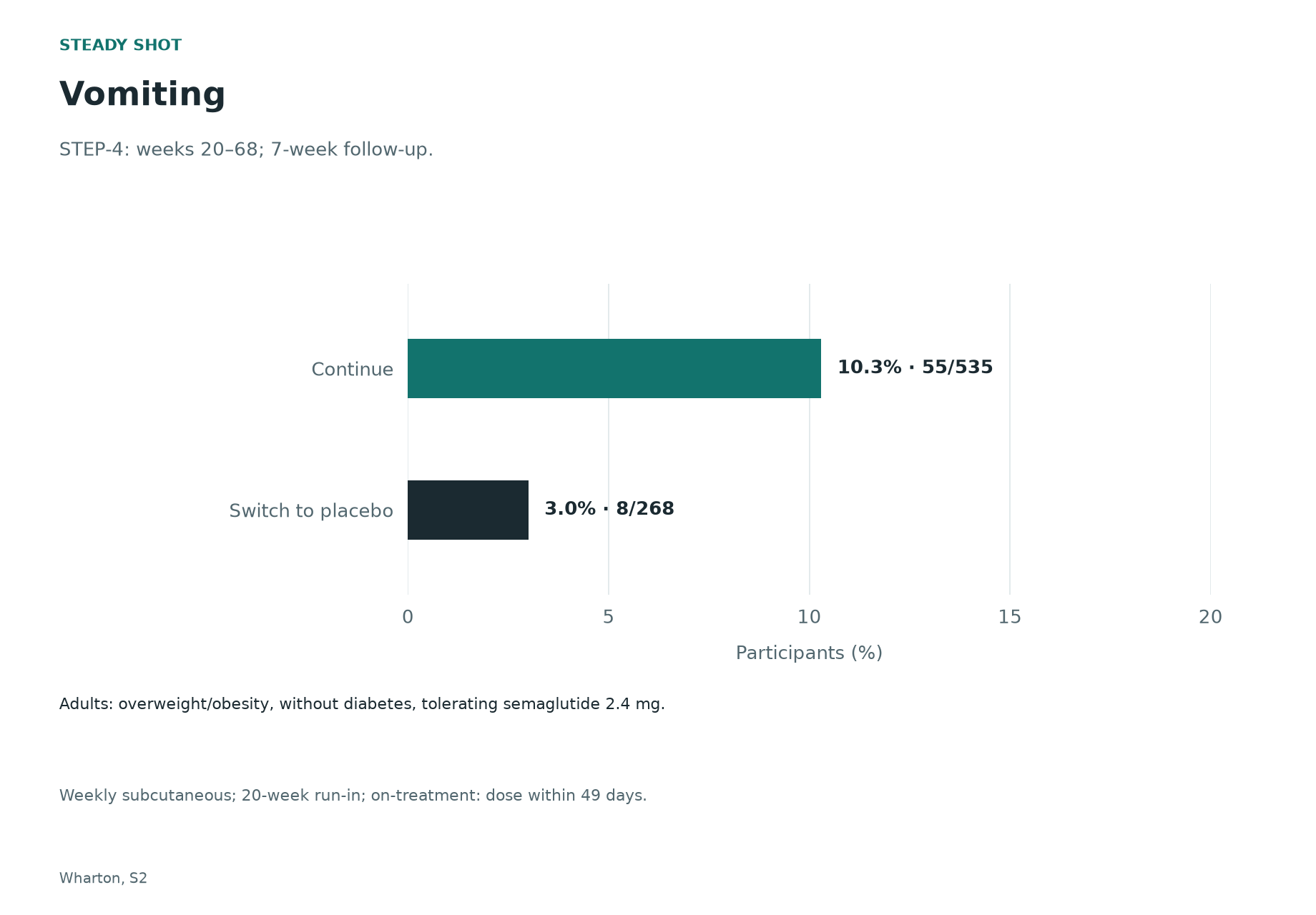
Vomiting
STEP-4: weeks 20–68; 7-week follow-up.
Adults: overweight/obesity, without diabetes, tolerating semaglutide 2.4 mg.
Weekly subcutaneous; 20-week run-in; on-treatment: dose within 49 days.
Sources: [1]
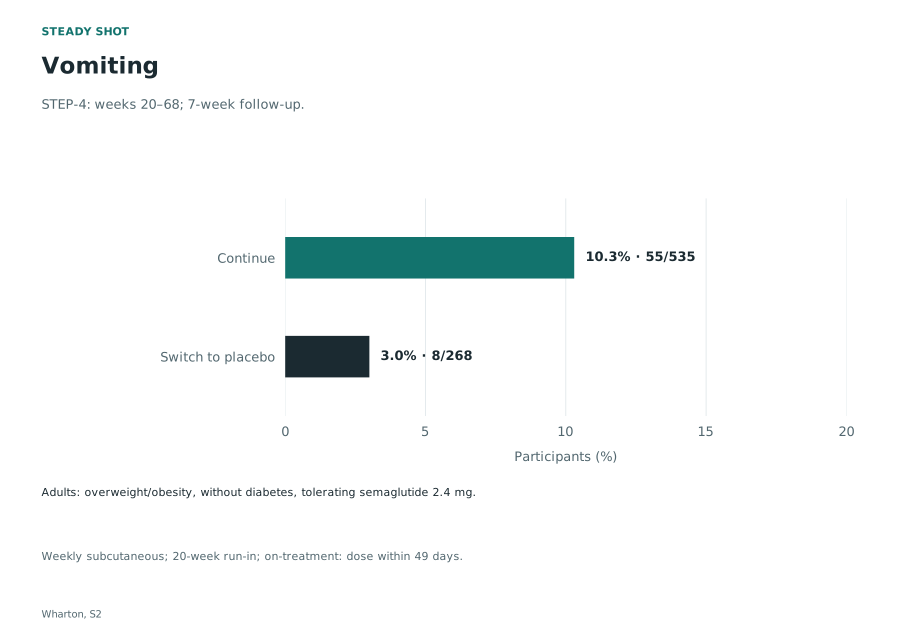
| Assignment | n/N | Percent |
|---|---|---|
| Continue | 55/535 | 10.3% |
| Switch to placebo | 8/268 | 3.0% |
The second entry point defines a different question
Wharton’s post hoc report examined continuation separately; Novo Nordisk funded the trials, with three employee-shareholder authors.
Consider the logic of a study with an initial entry point followed by a later allocation. The later comparison has its own eligibility conditions. Reaching that point is part of the definition of the population being compared. A statement about that population should retain the condition, rather than quietly expanding into a statement about everyone who might consider treatment. This is a change in the target question, not a criticism of a study for answering the question it actually posed.
The scientific task is to distinguish the people a result describes from the people a reader hopes it describes. If those groups differ, the next step is to name the relevant difference and ask whether it could alter the outcome or the treatment contrast. It would be equally unjustified to assume perfect transfer or to assume that no transfer is possible. An explicit eligibility condition gives the reader something concrete to investigate. Without that condition, an apparently simple statement about tolerability can conceal several different populations.
Sources: [1]
Two clocks can describe the same observation
A timeline can start when exposure begins or when the strategies under comparison diverge. Those starting points answer different questions. Time since first exposure describes a treatment history; time since assignment locates an observation relative to a comparison. Moving an outcome from one clock to the other changes its meaning unless the earlier interval is also accounted for. An elapsed duration without a named origin is therefore incomplete scientific information.
A useful reading exercise is to draw separate lines for exposure, allocation and observation. Then place each stated outcome on the line to which its definition belongs. This does not require reconstructing an individual course or assuming a constant chance of symptoms over time. In particular, dividing a whole-window proportion by the window length would introduce assumptions that the proportion itself does not supply. A dated event record would be needed to study how occurrence changes across time. Our side-effects timeline guide is a separate reading destination; its timeline should not replace the time origin attached to a research result.
Sources: [1]
A comparator has a past as well as a name
When two strategies diverge after a shared earlier intervention, the comparison concerns what happens after that divergence. A label describing only the later assignment leaves out the common history. The meaningful contrast includes both parts: the earlier experience that defines entry and the alternative strategies that follow. This is why changing to a comparator is conceptually different from receiving that comparator from the beginning.
That distinction alone does not establish a lingering biological effect, its duration or its direction. Those would be empirical questions requiring appropriate measurements. It establishes something more basic: the interventions being contrasted have different definitions across the two research questions. A study of initial choices would need to begin at the initial decision, while a study of later choices would need to define the history that makes the later choice relevant. The guide to stopping a GLP-1 offers another place to examine questions about treatment change. Reading about a change, however, does not turn a comparison of strategies into instructions for making that change personally.
Sources: [1]
Random assignment and representativeness do different work
Random assignment addresses how comparison groups are formed within a defined study population. Representativeness concerns how that population relates to a different population of interest. These questions can be separated logically. A comparison may be well constructed for eligible participants while leaving uncertainty about people who could not enter it. Conversely, resemblance to a broad population does not by itself solve problems in how treatment groups were formed.
To assess transfer, specify which characteristics or prior experiences differ and why those differences might matter for the outcome. A difference that changes the overall chance of a symptom need not necessarily change the contrast between strategies; those are separate possibilities to investigate. Neither possibility should be assumed from the existence of selection alone. The table below is an original map of research questions, not a description of additional study results. Its purpose is to align the decision, the comparison and the population before seeking a numerical answer.
The relevant differences need not be limited to basic demographic labels. A prior experience or an entry condition may be central to the decision under study. A defensible transfer argument should explain why the outcome comparison would remain informative after changing that condition, and identify what evidence could challenge that explanation.
| Decision point | Comparison to define | Population to follow |
|---|---|---|
| Considering first exposure | Alternative initial strategies from a common starting point | People eligible at that initial decision |
| Considering continued treatment | Alternative later strategies after a specified history | People meeting the conditions for that later decision |
| Considering a changed presentation | The original and proposed presentations under comparable conditions | People for whom the presentation change is intended |
Sources: [1]
A symptom indicator compresses an experience
An indicator records whether a specified condition was met. It does not, by its mathematical form, preserve every detail of the experience that produced it. Occurrence, recurrence, intensity and recovery require different fields. A yes-or-no endpoint can be useful precisely because it gives a defined answer, but the simplicity of that answer should not be mistaken for a complete account of the underlying events.
Suppose the research question concerns repeated episodes. The necessary records would include event dates and a rule for distinguishing a new episode from continuation of an earlier one. A question about disruption would instead need an explicit measure of activity or functioning. A question about recovery would need both a starting condition and a definition of resolution. These are proposals for measurement, not assertions about what a particular investigator did or did not collect. The plotted indicator cannot reconstruct those records. Keeping the measurement question explicit helps a reader identify the next useful endpoint rather than filling gaps with a plausible story.
The denominator deserves the same attention as the event. A proportion needs a rule identifying who belongs in the group being summarized. Changing that rule can change the question even if the numerator uses the same symptom definition. Interpretation therefore starts with both membership and measurement, rather than the percentage alone.
Sources: [1]
Assignment is not an exposure diary
A strategy label describes an assigned course of action. An exposure diary describes what was actually received over time. They can be connected only through additional records and clearly stated analysis rules. If the research question concerns the consequence of assignment, the assigned groups provide the organizing comparison. If it concerns a particular pattern of receipt, that pattern must be measured and its relationship to assignment examined.
This matters when a symptom result is used to suggest that treatment continued without interruption. Symptom occurrence and continuity are different variables; knowing one does not supply the other. Studying continuity would require definitions for a pause, a change and an end, together with a way to handle incomplete records. It would also require deciding whether the intended question is about the strategy offered or the exposure received. Our prescription-reading guide is a useful place to organize document questions. A written instruction can identify an intended regimen, but only an appropriate record can establish its implementation over the period being studied.
Sources: [1]
Product transfer needs its own evidence
Applying a finding to a different presentation requires specifying what has changed. Ingredient, route, concentration, preparation and delivery device are different descriptors. Sharing one descriptor does not logically establish that every other relevant feature is interchangeable. Equally, a visible difference in packaging does not demonstrate a difference in a clinical outcome. The evidentiary question should be stated at the level of the proposed change.
For example, a question about delivery accuracy calls for a defined target and a validated way to measure delivery. A question about biological exposure calls for measurements capable of assessing exposure. A question about a clinical outcome may require a comparison designed around that outcome. These are distinct steps in an argument; completing one does not automatically complete the others. The first-injection guide provides a separate practical reading destination. Here the scientific concern is how a claim is established, without assuming that any actual product has a defect or that a particular alternative reproduces a studied result.
A claim of equivalence also needs a definition of how much difference would matter and an analysis able to assess uncertainty around that difference. Similar-looking bars do not supply either requirement. This is a design question to resolve in advance, not a conclusion obtained by visually matching two outcomes.
| Proposed change | Evidence to examine | Claim still unresolved |
|---|---|---|
| Delivery device | Validated measurements of the intended delivery process | Whether relevant clinical outcomes are comparable |
| Concentration or preparation | A defined formulation comparison and appropriate exposure measurements | Whether the intended use produces comparable outcomes |
| Support process | Measures of the process and its implementation | Whether the process changes treatment outcomes |
Observation rules shape what an outcome means
An outcome needs both an event definition and a rule describing when observations count. Continued contact with a study and continued receipt of treatment are different states. A research record can therefore contain an observation without establishing uninterrupted exposure. Conversely, an exposure record does not guarantee complete outcome observation. The analysis must specify how these records relate before their contents can support a conclusion.
When checking a result, begin with the particular table and its footnote. A broad methods statement may address a different endpoint or analysis population. If two descriptions appear inconsistent, identify the scope of each before replacing one with the other. Missing information should remain missing rather than being silently interpreted as absence of symptoms. A proposed analysis of missing observations would need explicit assumptions and an assessment of how those assumptions affect the answer. Our missed-dose and storage guide is a separate document-reading resource. It cannot supply the individual exposure and observation records needed to resolve a research-data question.
Scope is especially important when one paper reports several outcomes. A rule appropriate to one endpoint may answer the wrong question for another. Reading the local definition first helps prevent a technically accurate statement from being attached to the wrong result.
Sources: [1]
Keep documentary claims separate from clinical measurements
A scientific claim becomes easier to evaluate when rewritten as an answerable question. Ask what would be compared, who would enter the comparison, what would be measured and when measurement would occur. A broad reassurance may combine several questions that need different evidence. Tolerability, effectiveness, delivery accuracy and economic value do not become the same outcome merely because they concern the same intervention.
Documentary review has a different role. Our compounded-product policy guide and MaxLife review can be used as starting points for examining documents; those links do not assign trial results to a provider or establish its current terms. The scientific task remains to identify the evidence needed for the specific clinical claim. The companion tirzepatide evidence analysis develops a related exercise in defining outcomes and treatment history. Reading the two analyses together should sharpen the questions asked of evidence, without treating separate drugs, products or comparisons as interchangeable.
A selected comparison does not replace prescribing information
Wegovy’s current prescribing information contraindicates use with personal or family medullary thyroid carcinoma, MEN2, or prior serious hypersensitivity to semaglutide or any ingredient. The boxed warning reflects rodent thyroid tumors; relevance to humans remains unknown. Warnings address pancreatitis, gallbladder disease, dehydration-related kidney injury and severe digestive reactions. Severe gastroparesis makes use not recommended. Obtain prompt assessment for severe or persistent abdominal pain; discuss persistent digestive symptoms with a clinician. Tell the anesthesia team about treatment. Graphs cannot prescribe dose changes.
The methodological point is that a focused research endpoint and prescribing information serve different purposes. A selected comparison describes a bounded question; clinical assessment must consider the person and the relevant safety information beyond that endpoint. The absence of a particular observation in a plot cannot create an exemption from considerations that the plot was not designed to evaluate.
Nor can the height of a bar decide an individual course of treatment. Such a decision involves information about the person, competing priorities and consequences that a group summary does not contain. Research interpretation is still valuable: it can identify the claim that is supported, the assumptions needed to extend it and the measurements that remain relevant. That is a disciplined use of evidence, with a clearer role than treating every published percentage as a personal forecast.
Questions about the evidence
Why does a later entry point matter?
It defines who could contribute to the later comparison. The important reasoning step is to retain that condition when describing the population represented by the result. To ask about an earlier decision, specify the people and alternatives relevant at that earlier point. That creates a different research question; it does not automatically invalidate the later one.
Sources: [1]
How should an observation clock be identified?
Name the event from which elapsed time is measured, then state the interval during which the endpoint is counted. Exposure, assignment and follow-up can have different starting events. Keeping them on separate timelines helps reveal when a claim has moved an outcome from one clock to another without the information needed to justify that move.
Sources: [1]
Does comparator history prove a lingering treatment effect?
No. A history belongs in the definition of the comparison, but its presence alone does not measure a biological mechanism. Demonstrating a lingering effect would require suitable observations and a design capable of separating that explanation from alternatives. The first task is to describe the contrast accurately; the mechanism is a further empirical question.
Sources: [1]
Does selection make a randomized comparison uninformative?
Selection and allocation concern different parts of the design. A result may address a defined eligible population while leaving uncertainty about transfer to another population. Evaluate that transfer by specifying the differences that might matter and the evidence bearing on them. Treating every selected population as representative, or every selected comparison as useless, avoids the actual scientific question.
Sources: [1]
What would support transfer to another presentation?
Start with a precise description of the proposed change. Then identify the measurements that could connect the original and proposed interventions for the claim being made. Delivery performance, biological exposure and clinical outcomes require different evidence. A shared descriptor can help formulate the comparison, but it cannot substitute for evidence addressing the relevant change.
Editorial assessment
The strongest interpretation begins with a complete question: a defined decision point, an eligible population, specified alternatives, an outcome and an observation rule. A continuation result can then be assessed within that structure. If the intended claim changes to initial treatment, a different presentation or uninterrupted use, the missing evidence becomes easier to name. The next useful investigation would need to address that changed claim directly, with measurements and entry conditions chosen for it. This approach preserves the value of a focused comparison while keeping its numerical result attached to the question it can answer.
Sources and access
- Wharton (2022): semaglutide tolerability
Article and supplement checked.
Checked .
- Rubino (2025): tirzepatide tolerability
Article and supplement checked.
Checked .
- DailyMed: Wegovy prescribing information
Current official label checked.
Checked .
- DailyMed: Zepbound prescribing information
Current official label checked.
Checked .
Coreage Rx pays us a commission on sign-ups through our links. It does not affect our scores or rankings. How we rate · Disclosure